

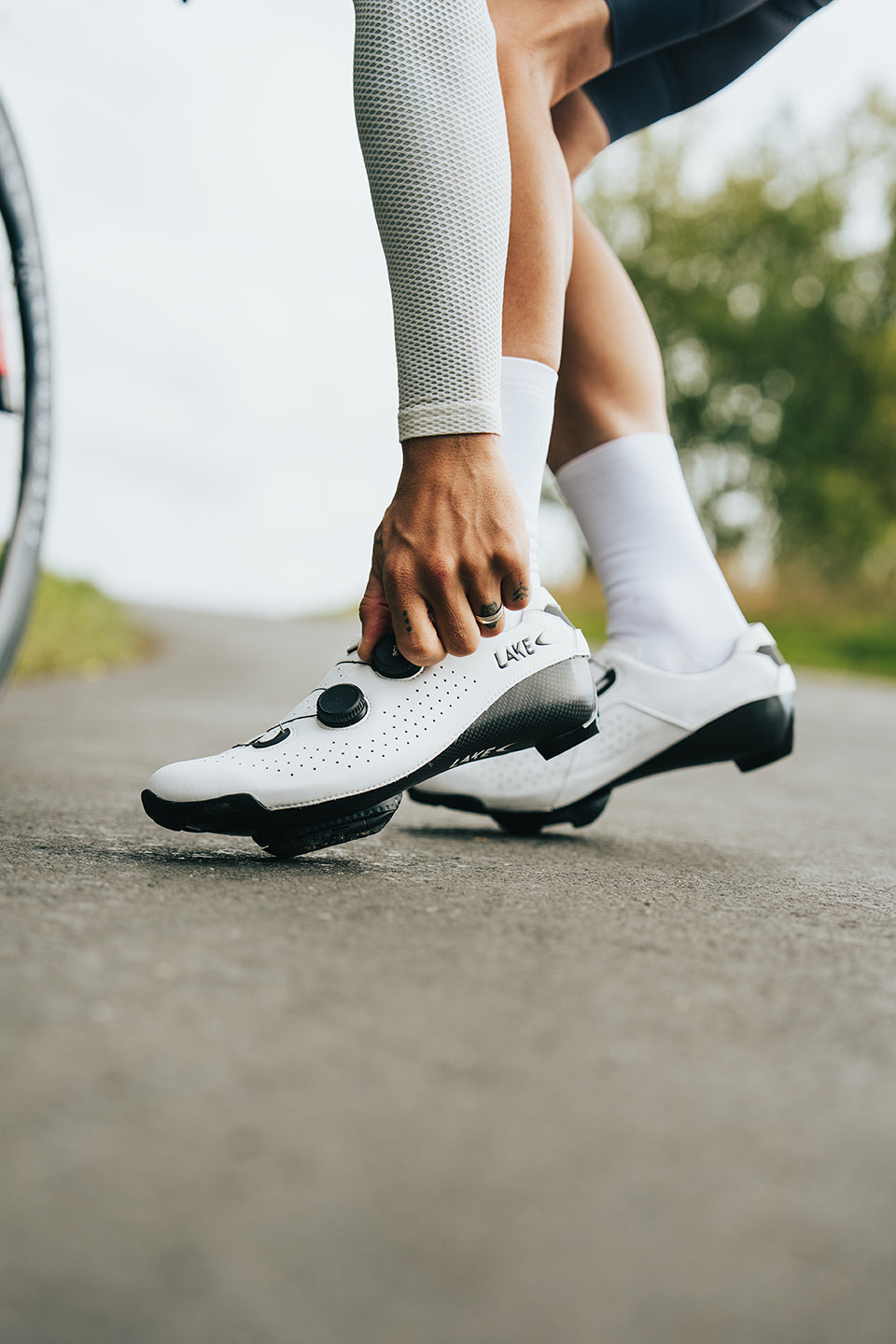
La mayoría de los ciclistas asume que, en cuanto a suelas de zapatillas de ciclismo, cuanto más rígida mejor. La lógica parece intuitiva: una suela más rígida pierde menos energía en flexión, así que más parte de tu esfuerzo llega al pedal. Compra la zapatilla más rígida del mercado y pedalearás más rápido. Esa suposición no es del todo errónea, pero es mucho más incompleta de lo que sugieren los textos de marketing, y actuar en consecuencia sin entender el cuadro completo puede dejarte con unas zapatillas que trabajan activamente en tu contra.
En este artículo explicamos qué hace realmente la rigidez de la suela, cuándo importa, cuándo no, y cómo elegir entre los niveles de construcción de suela de Lake Cycling según tu forma de pedalear. Sin puntuaciones inventadas ni números arbitrarios. Solo una explicación clara de los materiales, las construcciones y la diferencia práctica que marcan en la carretera.
Qué hace la rigidez de la suela (y qué no hace)
El principal argumento a favor de una suela rígida es la transferencia de potencia. Cuando empujas el pedal, una suela flexible absorbe parte de esa energía deformándose en lugar de transmitirla directamente a la interfaz de la cala. Una suela rígida actúa más como un brazo de palanca, canalizando la fuerza directamente hacia el eje del pedal. En teoría, pierdes menos energía.
En la práctica, la investigación al respecto tiene más matices.
Para ciclistas de élite que generan vatios sostenidos muy altos, la rigidez de la suela tiene un beneficio medible. Para la mayoría de los ciclistas, incluidos los aficionados serios y los amateurs de competición, la diferencia de potencia medida entre una suela composite de calidad y una suela de carbono completo es marginal. La brecha se estrecha aún más cuanto más larga es la salida, porque otras variables como la fatiga, el ajuste y la posición del sillín tienen un efecto mucho mayor sobre cuántos vatios llegan realmente al pedal.
Lo que la rigidez sí afecta de forma más fiable es la comodidad del pie con el paso de las horas. Una suela completamente rígida concentra toda la fuerza de pedaleo en una zona de contacto fija. Con cargas ligeras o en salidas cortas, esto se siente eficiente. Tras cuatro, cinco o seis horas, puede provocar entumecimiento del antepié, puntos de presión y compresión nerviosa, sobre todo si la zapatilla no ajusta con precisión o si la forma de tu pie no coincide con la horma.
Una suela con cierta flexión controlada distribuye la carga de forma dinámica a medida que el pie avanza en la pedalada, lo que reduce la concentración de presión en los esfuerzos largos.
La rigidez de la suela también interactúa con la posición de las calas. Una suela rígida amplifica cualquier desalineación entre la cala y la alineación natural de tu pie. Si tu cala está perfectamente colocada, una suela rígida te recompensa. Si está desviada aunque sean unos pocos milímetros, esa misma rigidez transmite la desalineación en cada pedalada, sin ningún efecto amortiguador.
El resumen honesto: la rigidez importa sobre todo para corredores de alta potencia en esfuerzos de menos de dos o tres horas. Para ciclistas de fondo, participantes en marchas cicloturistas y cualquiera que pedalee más de cuatro horas seguidas, la relación entre rigidez y comodidad se convierte en una consideración más relevante que la relación entre rigidez y vatios.

Los tres niveles de material de suela en Lake
La gama de carretera de Lake Cycling se estructura en tres niveles de material de suela bien diferenciados. Entender qué ofrece cada nivel, y qué no, es el punto de partida para elegir la zapatilla correcta.
Nivel 1: carbono completo
Las suelas de carbono completo ofrecen la mayor rigidez disponible en calzado de ciclismo. La fibra de carbono es excepcionalmente rígida en relación con su peso, lo que permite una suela fina y ligera que aun así actúa como una palanca casi completa. Este nivel encaja con ciclistas que optimizan la transmisión de potencia, que tienen las calas perfectamente ajustadas y que ruedan a intensidades en las que merece la pena priorizar las diferencias marginales de rendimiento.
El nivel de carbono completo de Lake abarca las CX403, CX400, CX400L, CX333 y CX302. Dentro de este nivel existen dos métodos de construcción distintos, y esas construcciones importan tanto como el propio material.
Nivel 2: composite de carbono
Las suelas de composite de carbono incorporan fibra de carbono junto a otros materiales, normalmente fibra de vidrio o polímero reforzado. El resultado es una suela que ofrece una rigidez y un retorno de energía claramente mejores que el nailon, conservando un grado de flexibilidad que la hace más tolerante en distancias largas o en entrenamientos donde la rigidez absoluta es menos crítica.
Este nivel es adecuado para ciclistas que combinan entrenamiento y salidas exigentes, para quienes están construyendo su forma física, o para cualquiera que quiera una zapatilla genuinamente orientada al rendimiento sin el precio ni la rigidez sin concesiones del carbono completo.
La CX201 pertenece a este nivel. Lleva una suela de composite de carbono, no una suela de carbono completo. Esa distinción importa.
Nivel 3: composite de nailon
Las suelas de composite de nailon ofrecen una flexión controlada y predecible. No intentan ser carbono completo. Cumplen otro propósito: proporcionar una plataforma estable y cómoda a ciclistas recreativos, usuarios de fitness y cualquiera que valore una zapatilla que acompaña el movimiento sin castigar la imprecisión.
La rigidez es la apropiada para los niveles de potencia y las duraciones de salida típicos de esta categoría. Las CX190 y CX178 usan suelas de composite de nailon. No son suelas de principiante en ningún sentido despectivo. Están correctamente diseñadas para los ciclistas a los que van destinadas.
Las construcciones especiales de Lake dentro del carbono completo
Dentro del nivel de carbono completo, Lake utiliza dos métodos de construcción propios. No son variaciones del mismo enfoque. Resuelven problemas distintos y ofrecen sensaciones de pedaleo distintas.
Construcción monocasco de carbono
En una zapatilla monocasco de carbono, la fibra de carbono no forma solo la suela. Forma el núcleo estructural de toda la zapatilla. El empeine envuelve una estructura de carbono integrada que incluye la suela, los laterales y el contrafuerte del talón como una única unidad continua. No hay una suela separada unida a un empeine separado. Son una sola pieza.
El resultado es una rigidez torsional excepcional y una sensación extremadamente cercana y conectada entre el pie y el pedal. Como el contrafuerte del talón forma parte de la misma estructura de carbono que la suela, el levantamiento del talón bajo cargas altas se minimiza. La zapatilla se comporta como una única unidad rígida en lugar de como dos componentes trabajando juntos.
Las CX403, CX400 y CX400L usan la construcción monocasco de carbono. La CX403 añade la capacidad de termomoldeado: la zapatilla puede moldearse con calor alrededor de tu pie para un ajuste verdaderamente a medida. Las CX400 y CX400L logran su rendimiento mediante una geometría de flexión diseñada en el talón que se adapta a la mayoría de las formas de pie sin el paso del moldeado. La CX400 usa cierre BOA Li2. La CX400L usa cierre de cordones, para ciclistas que prefieren la sensación y la sujeción de los cordones frente a un sistema de rueda.
Sistema de doble suela
La doble suela aborda el problema de la rigidez desde otro ángulo. En lugar de usar un único elemento rígido, utiliza dos capas con propiedades mecánicas diferentes trabajando en combinación. Una plataforma interior semiflexible de fibra de vidrio queda suspendida sobre una suela exterior rígida de 100% carbono. La plataforma interior puede moverse ligeramente respecto a la suela exterior, lo que le permite amortiguar vibraciones y distribuir la presión de forma dinámica mientras la capa exterior de carbono mantiene la función de palanca rígida para la transferencia de potencia.
El efecto práctico es una suela que se siente menos castigadora en salidas largas o sobre asfalto en mal estado que una construcción de carbono completo de una sola capa, sin sacrificar la rigidez estructural que hace que las suelas de carbono merezcan la pena. Es una solución meditada para ciclistas que necesitan rendimiento y resistencia en esfuerzos prolongados. Tanto la CX333 como la CX302 usan el sistema de doble suela.
La CX333 es la expresión premium de esta construcción: talón Thermaform termomoldeable, un panel de arco de fibra de carbono Carbitex, BOA Li2 y empeine a elegir entre piel de canguro o microfibra Clarino, en tres anchos. La CX302 ofrece la misma arquitectura de doble suela a un precio inferior, con microfibra Clarino y panel Carbitex.
Modelos de carretera Lake por material de suela
Usa esta tabla como referencia rápida al comparar modelos de la gama. Todos los detalles de cada modelo están en la colección de zapatillas de carretera.
|
Modelo |
Material de la suela |
Construcción |
|---|---|---|
|
CX403 |
Carbono completo |
Monocasco |
|
CX400 |
Carbono completo |
Monocasco |
|
CX400L |
Carbono completo |
Monocasco |
|
CX333 |
Carbono completo |
Doble suela |
|
CX302 |
Carbono completo |
Doble suela |
|
CX201 |
Composite de carbono |
Estándar |
|
CX190 |
Composite de nailon |
Estándar |
|
CX178 |
Composite de nailon |
Estándar |
Si el ancho del ajuste es una prioridad, ten en cuenta que la CX201 solo está disponible en Regular. Las CX333, CX302, CX400, CX400L, CX190 y CX178 ofrecen opciones Regular y Wide. Las CX333 y CX302 están disponibles en tres anchos.
Si no tienes claro qué horma encaja con la forma de tu pie, la Lake Fit Matrix es el punto de partida adecuado, y la guía de zapatillas de ciclismo para pies anchos trata la cuestión del ancho en profundidad.
La gama de carretera Lake al completo
CX403
La zapatilla de carretera insignia. La construcción monocasco de carbono integra suela, laterales y contrafuerte del talón en una sola unidad, envuelta en piel de canguro con cierre BOA Li2. Termomoldeable para un ajuste a medida, lo que la convierte en la elección para ciclistas con pies de forma compleja o para cualquiera que haya tenido dificultades para encontrar una zapatilla estándar que ajuste con precisión. Race Last. Ideal para carreras en carretera, critériums y entrenamientos de alta potencia donde cada ganancia marginal cuenta.
CX400
Construcción monocasco de carbono con empeine de microfibra Clarino y cierre BOA Li2. Disponible en Regular y Wide. Gracias a la geometría de flexión diseñada en el talón, la mayoría de los ciclistas no necesitará el termomoldeado. Es la puerta de entrada más accesible a la construcción monocasco de carbono de Lake, con el mismo rendimiento estructural que la CX403 a un precio inferior. Race Last.
CX400L
Idéntica a la CX400 en construcción y suela, con cierre de cordones en lugar de la rueda BOA. Disponible en Regular y Wide. La elección para ciclistas que prefieren la sujeción precisa y uniforme de los cordones frente al microajuste progresivo de un sistema BOA. Monocasco de carbono, Race Last.
CX333
El sistema de doble suela en su versión más completa. Una plataforma interior semiflexible de fibra de vidrio suspendida sobre una suela exterior rígida de carbono, combinada con un panel de arco Carbitex y talón Thermaform termomoldeable. El empeine es a elegir entre piel de canguro o microfibra Clarino, con cierre BOA Li2 y tres opciones de ancho. Si quieres la rigidez del carbono completo pero las suelas de carbono de una sola capa te resultan incómodas en distancias largas, la CX333 es el modelo a considerar. Race Last.
CX302
El sistema de doble suela a un precio que lo hace accesible a un abanico más amplio de ciclistas. Mismo principio de construcción que la CX333: plataforma interior de fibra de vidrio sobre suela exterior rígida de carbono. Empeine de microfibra Clarino con panel Carbitex, BOA Li2, tres anchos. Si ruedas mucho y quieres el beneficio de la amortiguación de vibraciones de la doble suela sin pagar por el talón Thermaform ni las opciones de empeine premium de la CX333, la CX302 es la elección racional. Race Last.
CX201
Suela de composite de carbono, un paso claro por encima del nailon en rigidez y retorno de energía, conservando la ligera flexibilidad que la hace más cómoda que el carbono completo en entrenamientos largos. Empeine de microfibra Clarino con malla transpirable, BOA Li2. Comfort Plus Last, solo en Regular. La elección correcta para ciclistas de fondo, participantes en marchas cicloturistas y cualquiera que quiera una zapatilla de rendimiento que no exija perfección en el ajuste de las calas.
CX190
Suela de composite de nailon con doble cierre BOA L6, empeine de microfibra y malla, disponible en Regular y Wide. Sport Last. La CX190 ofrece una plataforma estable y cómoda para usuarios de fitness y ciclistas recreativos que no persiguen ganancias marginales de rendimiento pero quieren una zapatilla de calidad que dure. El doble cierre BOA te da un ajuste independiente en el antepié y el mediopié.
CX178
Suela de composite de nailon con cierre BOA L6, empeine de microfibra con puertos de ventilación, disponible en Regular y Wide. Sport Comfort Last. La zapatilla más accesible de la gama de carretera Lake. Diseñada para ciclistas recreativos y de iniciación al rendimiento que quieren una zapatilla bien fabricada con la rigidez apropiada para los niveles de potencia típicos de este segmento.
Cuándo más rigidez hace más daño que bien
Existen razones reales para elegir menos rigidez, y merece la pena ser directos al respecto.
Entumecimiento del antepié.
La queja más habitual sobre las suelas rígidas en salidas largas es el entumecimiento del antepié, sobre todo en la zona de las cabezas de los metatarsianos. Una suela totalmente rígida concentra la presión del pedaleo en una zona fija del pie. Con el tiempo, esa presión comprime nervios y vasos sanguíneos.
Algunos ciclistas lo solucionan por completo con la posición de las calas y la elección de plantillas. Otros descubren que pasar a una suela con algo de flexibilidad, o al sistema de doble suela, elimina el problema sin ningún coste de rendimiento medible.
Amplificación del ajuste.
Una suela rígida no perdona un ajuste impreciso, lo amplifica. Si tu zapatilla queda aunque sea ligeramente estrecha en el antepié, una suela rígida de carbono fija esa presión durante toda la salida. Una suela con algo de flexión permite que la zapatilla absorba de forma dinámica los pequeños puntos de presión.
Esta es una de las razones por las que los modelos con Sport Last y Comfort Plus Last usan suelas composite y de nailon en lugar de carbono completo: la geometría de la horma y la rigidez de la suela están adaptadas entre sí y al tipo de ciclista para el que está diseñada la zapatilla.
Fondo frente a sprint.
Un corredor de critérium que produce arranques cortos y explosivos se beneficia de un brazo de palanca lo más rígido posible. Un ciclista de audax que recorre 200km un sábado necesita una zapatilla que distribuya la carga de forma inteligente durante doce horas. No son los mismos requisitos.
Elegir una zapatilla por su especificación de rigidez sin considerar la duración y la intensidad de tus salidas es elegir la variable equivocada.
Clima frío.
Las suelas de carbono conducen el frío. A bajas temperaturas, una suela de carbono completo extrae el calor del pie con más eficiencia que una suela composite. Rara vez es un factor decisivo para ciclistas con zapatillas de invierno adecuadas o calcetines térmicos, pero conviene saberlo si estás pensando en usar zapatillas de competición en condiciones de frío.
Si no tienes claro en qué punto de este espectro te encuentras, la guía para elegir zapatillas de ciclismo cubre el marco de decisión más amplio. Para MTB y gravel, donde la construcción de la suela sigue prioridades completamente distintas, la gama de zapatillas de MTB parte de otros principios.
Preguntas frecuentes
¿La rigidez de la suela realmente te hace más rápido?
Para la mayoría de los ciclistas, el efecto directo sobre la velocidad es pequeño. El beneficio más claro de una suela más rígida es la menor pérdida de energía a potencias muy altas, algo relevante sobre todo para corredores y sprinters. Para ciclistas de fondo y recreativos, el ajuste, la posición de las calas y el entrenamiento tienen un efecto mucho mayor sobre el rendimiento que la rigidez de la suela. Elegir la rigidez adecuada para tu tipo y duración de salida importa más que elegir siempre la opción más rígida disponible.
¿Publica Lake índices o puntuaciones de rigidez de sus suelas?
No. Lake no publica índices numéricos ni puntuaciones de rigidez de sus suelas. La información relevante es el nivel de material de la suela, el método de construcción y el tipo de horma, todo ello claramente especificado en cada modelo. Si ves un número de rigidez asociado a una zapatilla Lake en un sitio de terceros, ese número no lo ha publicado Lake.
¿Cuál es la diferencia entre la construcción monocasco de carbono y el sistema de doble suela?
Monocasco de carbono significa que la suela, los laterales y el contrafuerte del talón se forman como una única unidad integrada de carbono. La zapatilla tiene la máxima rigidez torsional y una sensación directa y conectada. El sistema de doble suela usa una plataforma interior semiflexible de fibra de vidrio suspendida sobre una suela exterior rígida de carbono.
Esta combinación mantiene la rigidez del carbono para la transferencia de potencia mientras la plataforma interior amortigua las vibraciones y distribuye la presión de forma más dinámica. El monocasco de carbono encaja con ciclistas que priorizan la rigidez absoluta. La doble suela encaja con quienes quieren el rendimiento del carbono completo con más tolerancia en salidas largas o superficies irregulares.
¿Puedo usar una zapatilla de carbono completo para salidas largas de fondo?
Sí, con el ajuste correcto. Muchos ciclistas de larga distancia experimentados usan zapatillas de carbono completo sin problemas, porque tienen la posición de las calas bien afinada, sus plantillas son apropiadas para la forma de su pie y sus zapatillas ajustan correctamente.
¿Cómo interactúa la rigidez de la suela con el ancho de la zapatilla?
Una zapatilla demasiado estrecha en el antepié crea una compresión que una suela rígida no tiene forma de aliviar. La suela fija la geometría del empeine, lo que significa que cualquier presión se mantiene durante toda la pedalada. Los ciclistas con pies anchos que usan zapatillas de horma estrecha suelen experimentar puntos de presión y entumecimiento que atribuyen a la suela, cuando el problema real es el ajuste. Acertar con el ancho, mediante la horma y la opción de ancho correctas, es más importante que cualquier especificación de la suela.
Las mejores zapatillas de ciclismo para invierno 2026: guía experta
Pain from narrow and tight-fitting cycling shoes